

One of the most time-consuming tasks during unemployment is searching for suitable jobs, finding them, and applying.
We log into platforms like Kariyer.net, LinkedIn, yenibiris.com, and Jooble, build our profiles, open dozens of tabs to review listings, and send our information and documents one by one. After a while, we can even apply for jobs without reading most of the content. Sometimes a job listing appears that feels too good to miss.
What the unemployed don't realize is that it could be a hook. An attractive listing turns people full of hope into targets of fraudsters and fake postings. It's not just carelessness at play; often, prolonged unemployment leaves people with no other secure or accessible exit route. Because job search periods grow longer and uncertainty reaches unbearable levels. When months pass without a response, a listing that says "start immediately, earn immediately" looks less like a real opportunity and more like an escape route. Fraudsters target exactly this need for hope.
Home packaging: attractive but unreal
"Home packaging" listings are a type of job posting increasingly encountered on social media and job boards in recent years.
These listings typically promise high daily or weekly earnings in exchange for packaging small items at home—soap, hair clips, socks, candles, keychains. No experience, diploma, or resume is required; the only condition appears to be finding time to work from home.
The language used in these listings adds to their appeal:
Daily earnings of 300–500 TL
Flexible working hours
No experience needed
Materials sent to your address
Approved / certified by İŞKUR
On the surface, the job looks appealing, but it's actually not real—it's a fraud scheme designed to collect personal data and money.
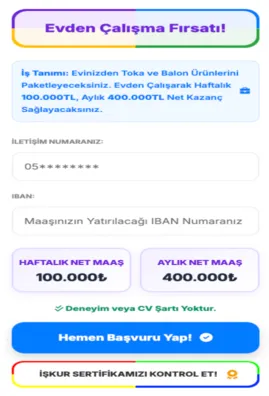
Monthly net salary promises of 400,000 TL
For job seekers, the scenario almost always plays out similarly. When you apply to a listing, the other party responds quickly, and the process moves through several stages. As unemployment drags on, this quick response itself feels reassuring, even though we now know that real employers often remain silent for weeks. This contradiction creates an opening for initial red flags to slip past unnoticed.
Let's look at the listings themselves.
The listings claim to offer wages far above market rates. This is a textbook example of the "too good to be true" principle—a classic feature of phishing scams. In a market where many full-time, office-based jobs don't pay at these levels, offering such figures is simply unrealistic.
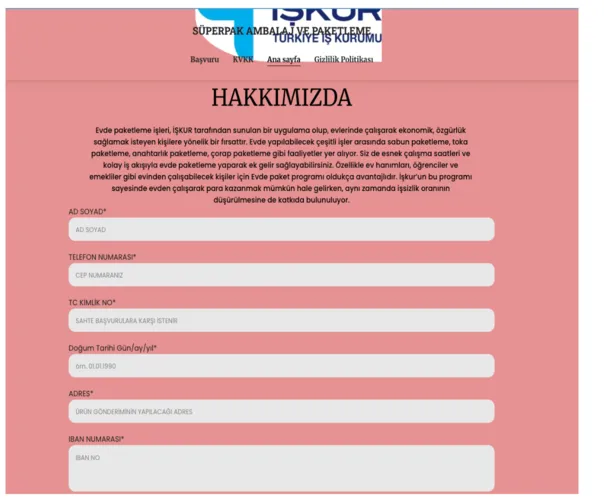
The website referenced in a Jooble listing.
Listings may request information that a legitimate employer wouldn't ask for during the application stage. Some ask for an IBAN; others go further and demand a national ID number. Yet these are pieces of sensitive data that should only be shared after a job offer is confirmed and an official contract is signed. Requesting such sensitive information at the application stage is, by itself, a serious red flag.
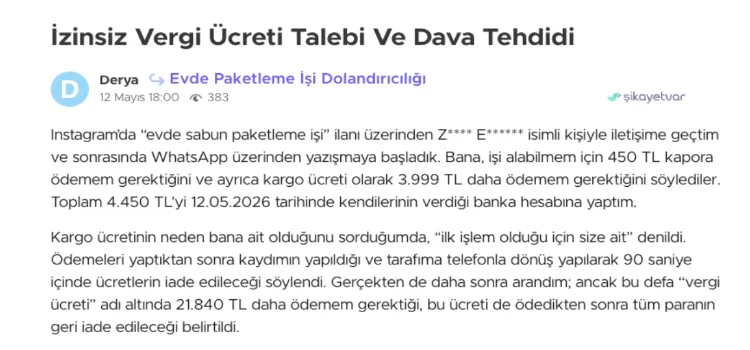
Fraudulent activity under the name Superpak Packaging has also been reported on Şikayetvar.
After collecting your information, you're asked to make an upfront payment—ranging from 200 to 2,000 TL—under the guise of "material costs," "shipping fees," "membership fees," or "security deposits." Payment is typically made to a personal account or digital wallet. After payment, either no materials are sent at all, or packaged products are rejected on the grounds that they "don't meet quality standards" and no payment is issued.
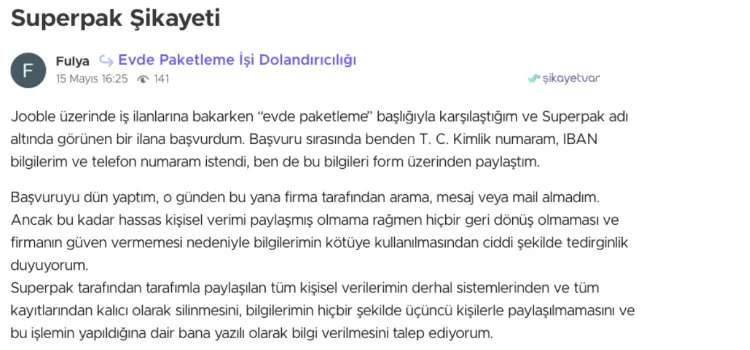
Often communication ceases entirely; sometimes victims are threatened with legal action.
Another complaint filed.
Watch out for "İŞKUR" references
Fraudsters often use phrases like "İŞKUR certified" or "an application provided by İŞKUR" in their listings to build trust. However, İŞKUR never gives such "approval" to private companies. In a statement, İŞKUR itself clarified that it does not offer any work model under the names home work, home packaging, or supplementary work from home, and explicitly warned against this.
The only reliable way to verify whether a listing is genuine is to check the official İŞKUR website at "iskur.gov.tr" or call "Alo 170". That is, you should not trust "İŞKUR approved" labels on third-party job boards.
Where are these listings?
In my brief research for this article, I encountered multiple examples. The vast majority of listings I found are distributed through two channels: Google ads and sponsored content on job aggregator sites like Jooble. The fact that sponsored content creates the impression of being "published on a trustworthy platform" amplifies the trap's effectiveness.
An example I encountered looked like this:
Believing these listings violate Google's ad policies, I filed a report with Google on this matter. As of the date this article was written, I received no response.
Google's "Misrepresentation" ad policy explicitly bans ads offering fake job opportunities. Even more importantly, in Google's November 2025 announcement on "fraud and deception," fraudsters' tactics—demanding upfront registration or transaction fees, using fake application forms, and collecting bank details and identity documents—were specifically highlighted.
Despite the company's own policy explicitly banning such listings, they continue to appear online, which only highlights the gaps in the moderation system. Since ads in Google's Ad Transparency Center can only be searched by advertiser name, it's practically impossible to trace these listings, which constantly change names and domains, after the fact.
Jooble has an article titled "Common job scams on Jooble" in its own help center. The platform says its moderation team reviews listings but caution is still advised—an indirect admission that the platform knows about the problem but can't prevent it sufficiently. See here.
Both job listing platforms and advertising companies like Google largely shift the burden of verifying whether a listing is genuine onto the job seeker's shoulders. As unemployment deepens, demand for such listings increases, but in return there's no accountability—only silence. The system expects people already going through a precarious process to single-handedly police the listings themselves.
Never assume
Unemployment is one of the most difficult periods a person faces, both economically and psychologically. As the process drags on, a listing that says "start immediately, earn immediately" begins to look less like a real opportunity and more like an escape route. Fraudsters target exactly this need.
Skepticism is necessary but not sufficient. The appeal of these listings is not just a personal vulnerability—it's also a consequence of inadequate reliable job search channels and prolonged unemployment. In a system that places the burden of verification on job seekers, we can't expect everyone to play detective before every application. Still, when you encounter a listing, asking yourself three questions is a good start.
Is the promised earning realistic given market conditions? Does the application stage request your IBAN or national ID number? Is any upfront payment being requested? If you answer "yes" to even one of these questions, the safest choice is to stay away from that listing.
If you're unsure whether a listing is real, you can verify it through iskur.gov.tr or by calling Alo 170. If you've been victimized, you can file a complaint with İŞKUR and relevant consumer platforms, and if you suspect your identity information has been compromised, you can pursue legal action. The KVKK (Personal Data Protection Authority) also states that individuals in such situations should resort to legal remedies.
The problem doesn't end with isolated listings. That's why the aim of this article is not just to warn against falling for the hook, but to make visible the conditions that make it easy to fall for. As long as prolonged unemployment, scarce reliable channels, and the placement of verification burden on individuals remain unchanged, these traps will continue to return under new names.