
You submit your application. You are invited to an interview. Then you wait for results. When no answer comes, you start wondering when you will hear back. Eventually, you write an email or message to ask. Because you have to chase them down if they don't respond. Then you find yourself sending two or three more emails just to get a rejection. So when you hear "we will get back to you" in your next interview, what you should say is: No, we will get back to you.
Once, a common closing line in job interviews was "we will get back to you." In recent interviews I have attended, similar phrases are sometimes used, but it is clear that both the formula and the practice have shifted.
What is "we will get back to you" really saying?
This sentence carries more weight than we might think. More than a technical notification. It is an admission that the employer accepts responsibility in communication.
As the process begins, both sides proceed with mutual communication. The job seeker sends an email with their application or submits their information through a platform. The employer confirms receipt. After review, they send an email. They indicate whether the process will continue. Or they respond positively. This time the job seeker and employer agree on a common time for an interview. In theory, the process proceeds this way.
Philosopher Niels de Haan describes this relationship through the principle of "communicative reciprocity." Through communicative reciprocity, the employer and candidate entering the recruitment process incur an obligation to inform each other openly and promptly of decisions that affect the outcome of the process. Therefore, there arises an obligation to provide information about the result of the process within a reasonable timeframe.
But does it actually work that way?
Not entirely.
The responses to Ihire's question about at which stage employers stop communicating with job applicants (ghosting) reveal different breaks in communication at different stages of the process. For example, in what we might describe as the initial stage—after an application is submitted—the data shows that employers cut off communication with job seekers in 28 percent of cases.
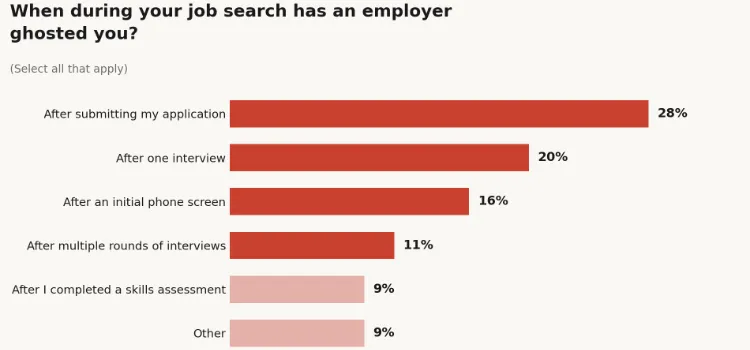
In the final stage, when an offer is made, communication breaks off in four percent of cases. This means communication is sometimes severed even after someone has been accepted and an offer has been made. There is no comparable data on this issue in Turkey. However, the production of such data and its use to inform policy in this area is essential.
Why does this happen?
The balance between employer and job seeker has been disrupted.
The recruitment process appears on paper to be a mutually engaged process between both parties. But the investment each party makes in this process is often unequal. The job seeker prepares a tailored CV and cover letter, performs unpaid tests or sample work, updates their portfolio, attends several interviews, pays for transportation, and spends time that could have been devoted to other job applications on this particular opportunity. If the job seeker does not receive a negative response when they apply, if communication cuts off after interviews, if they are not told why another candidate was chosen over them, the only thing the unemployed person gains from the process is a temporary possibility of being hired.
In job application processes, an imbalanced relationship forms: the job seeker gives their labor, time, and information, while the employer uses all this knowledge and effort to make a better choice for themselves.
There are other reasons that tilt the balance against job seekers in the job search process. For example, macroeconomic factors. As the economy worsens and the number of job seekers grows, the employer gains leverage: if they do not respond to one candidate, another is waiting. For the unemployed person, the situation is different; because they need employment, they cannot walk away from the relationship.
Careful application preparation, quick responses, patient waiting, appearing "professional" even after rejection. All of this is the candidate's responsibility. Responding, providing explanation, recognizing effort—these are now optional luxuries for the employer.
Thus, reciprocity exists on paper, but in practice, responsibility falls entirely on one side.
So what is really wanted?
As we reach the conclusion, this needs to be clear: the job seeker is not asking for every application to be accepted. They are not demanding that every effort be rewarded with a job offer.
What they want is much simpler: to be able to communicate, whatever the outcome, at the end of a process in which they have invested time and effort. To receive feedback. To better understand where the problem lies.
The real problem with communication breakdowns is precisely here. It does not eliminate reciprocity; it simply places it entirely on one side.
So, in this imbalance, what can strengthen the job seeker's position?